
AI Action Summit: AI Openness Report

Released on 11 February 2025
Reporting hot off the press from the AI Action Summit, Paris, 10–11 February 2025, the third Global AI Summit, hosted by President Macron and co-chaired by Prime Minister Modi of India, this report captures the moment openness moved to the centre of the global AI conversation. From the launch of ROOST’s open source AI safety tooling and the Current AI public good foundation (€400m at launch, targeting $2.5bn), to the DeepSeek Effect and the continuing debate over what “open source AI” means, it sets out what the Summit’s shift from safety to action means for the UK and the open source community.
Report Includes:
Introduction and Conclusion
- Introduction to the AI Action Summit Report, Amanda Brock, CEO, OpenUK
- Conclusion, Dr Jennifer Barth, Founder, Symmetry and Research Director, OpenUK
The AI Action Summit, Paris
- Summit themes and outputs: Public Interest AI, sustainability, international AI governance, President Macron’s €109bn investment announcement and the EU AI strategy
- The launches of ROOST (Robust Open Source Safety Tools) and the Current AI foundation with its data commons
- The Road to the Action Summit: State of Open Con London, the Linagora Paris Open Source AI Summit (and the LUCIE LLM), and the Tony Blair Institute’s “Governing in the Age of AI”
- Pre-Summit reports on AI openness: the Bengio International AI Safety Report, Open Knowledge Foundation/Open Future on data governance, and Mozilla’s Columbia Convening
What is AI Openness or Open Source AI
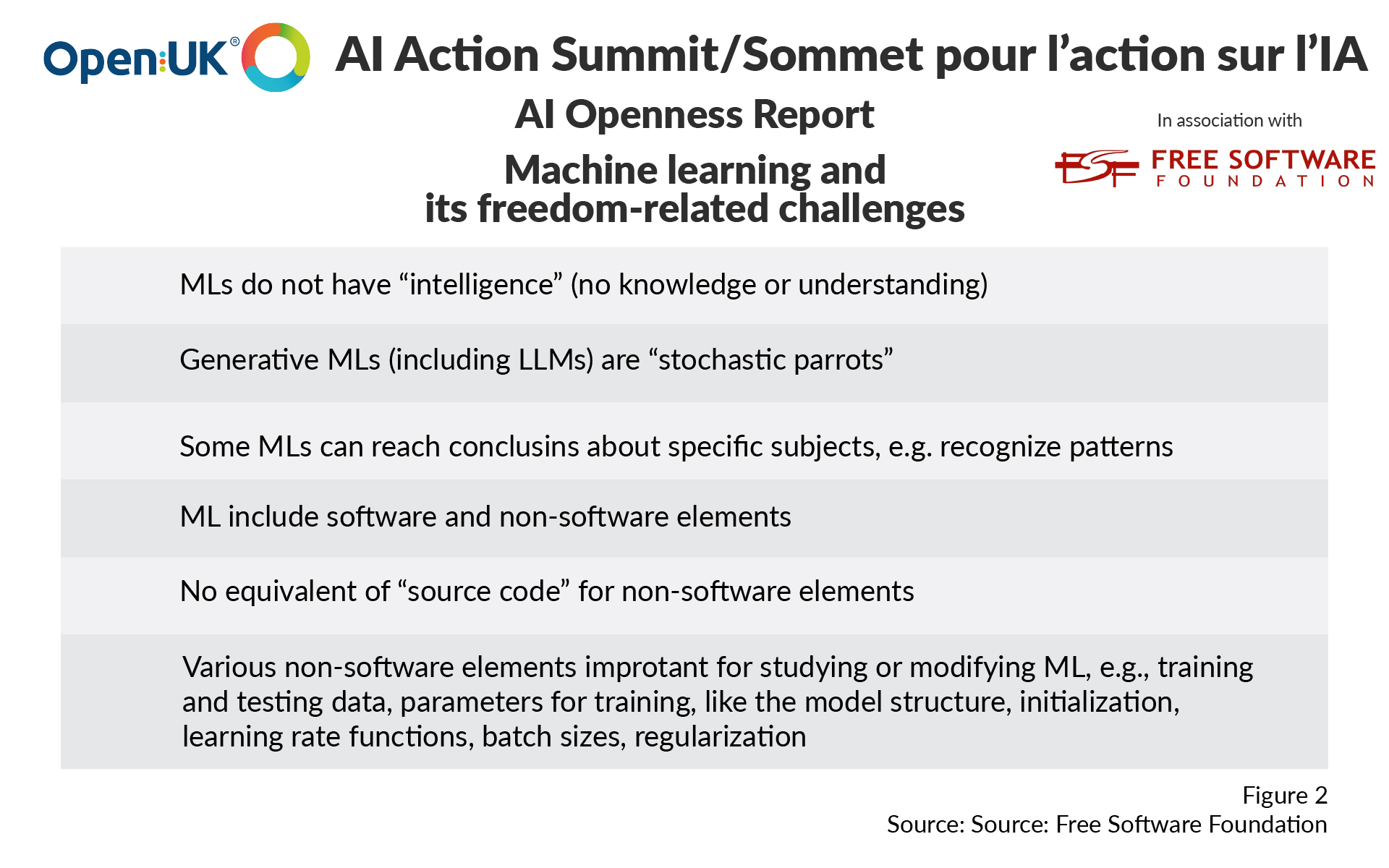
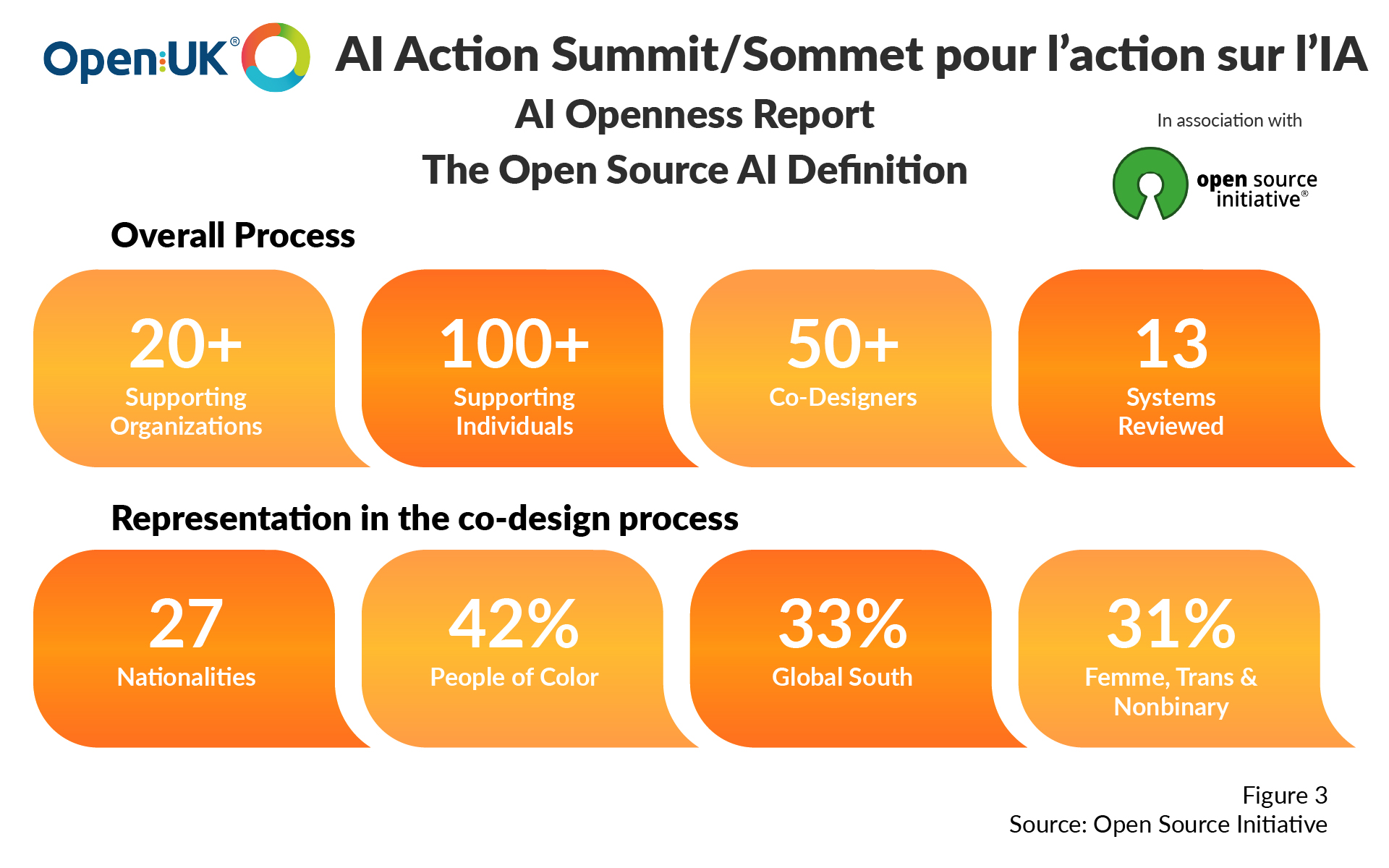
- The definition approach: Free Software Foundation, the OSI’s Open Source AI Definition (OSAID), and the Open Source Alliance’s Open Weights Definition
- The disaggregation approach: Stanford AI Index, House of Lords LLM Report, Radboud University’s open-washing research, Mozilla Columbia Convening
Policy Update and Timeline
- Country-by-country policy update: France, the UK (AI Bill, Copyright and AI consultation, AI Opportunities Action Plan), the EU, the US and China, plus the challenge of standards
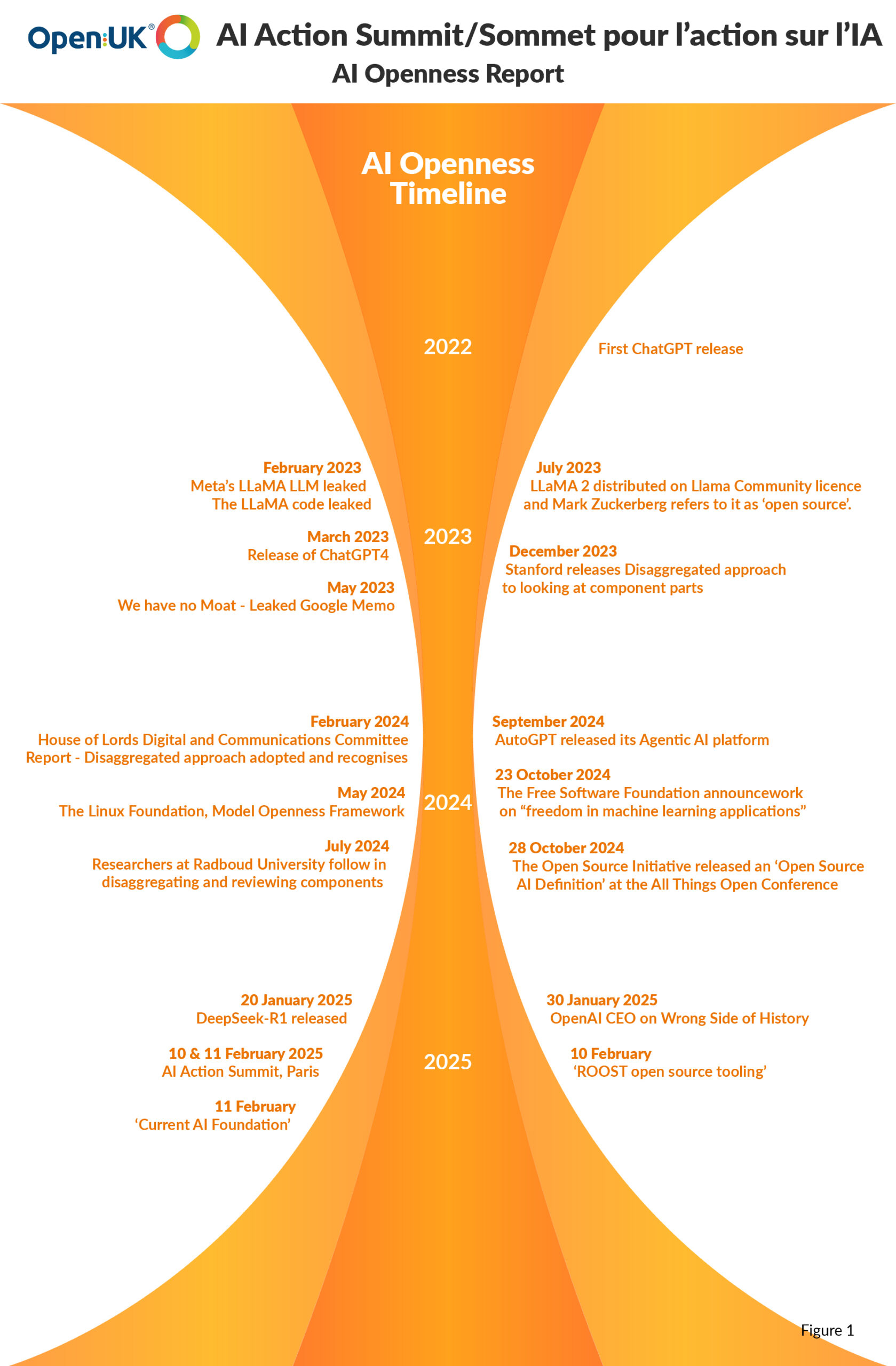
- The AI Openness Timeline: from ChatGPT’s release and the Llama leak through to R1 and the Paris Summit
With quotes from Summit participants
- Mike Bracken, Professor John McDermid OBE FREng, Clint Smith, Dr Laura Gilbert, Martin Tisné, Aviya Skowron, Anastasia Stasenko, Yann Lechelle and Mark Surman
Executive Summary
The AI Action Summit was the third Global AI Summit, two days in the Grand Palais with almost 1,000 attendees from business, government and civil society, and a decisive shift from safety to solutions, from rules to tools.
Openness takes centre stage
- Where the story goes that “open source” was uttered just twice at Bletchley Park, in Paris the term was used continuously across every discussion, beginning with the opening remarks
- Key outputs: a Global Dialogue on AI governance and Independent International Scientific Panel on AI; the launch of ROOST open source AI safety tooling with $30m in funding and the backing of Eric Schmidt and Yann LeCun (“tools not rules”); and the Current AI public interest foundation with €400m committed at launch, targeting $2.5bn over five years for data commons and ethical AI
- President Macron announced €109bn of AI investment for France; von der Leyen announced an EU AI strategy with a 5x supercomputer expansion; the End of Summit Declaration was signed by China but notably not by the US or UK
The DeepSeek Effect
- DeepSeek’s R1, released 20 January 2025 with weights on an open source MIT licence, reportedly cut LLM training costs by a factor of 20 (from $100m to $5m) by distilling existing open models, and knocked almost 20% off Nvidia’s stock in a day
- In the open source tradition, DeepSeek’s detailed documentation let Hugging Face begin work almost immediately on a fully open R1, iterative innovation in action
- Ten days later, Sam Altman conceded OpenAI had been “on the wrong side of history” on open source
The definition debate
- The meaning of “open source AI” remains contested: the OSI’s OSAID (October 2024) has drawn criticism over data disclosure and the risk of undermining the Open Source Definition; the FSF is drafting its own statement; the new Open Source Alliance launched an Open Weights Definition at the Summit
- The disaggregation approach, assessing openness of each component (code, weights, data), is gaining traction via Stanford, the House of Lords, Radboud University and Mozilla’s Columbia Convening
- Stanford’s AI Index found two thirds of LLMs released in 2023 were open source, up from 44.4% in 2022 and 33.3% in 2021
The policy landscape
- France is now number one in Europe in open source AI (Tortoise Index, September 2024), with the UK relegated to second in AI while remaining first in open source software
- The UK’s AI Bill remains untabled; the DSIT Copyright and AI consultation closed 25 February 2025; Matt Clifford’s 50-point AI Opportunities Action Plan was “mainlined” by the Prime Minister
- The US swung from Biden’s rescinded Executive Order to a light-touch, anti-regulation approach; China focuses on governance through standards; the EU began applying the AI Act on 2 February 2025 with no clear standards yet in place
Press Release and Related Press
OpenUK Annual Survey
Contribute to our Research by sparing 30 minutes to complete our survey in partnership with our Economists in Residence, The PSC – wherever in the world you are, whether you are working or not and whatever sector you might work in.