
“The Road to the AI Impact Summit: AI Openness Report” – Bangalore 2025
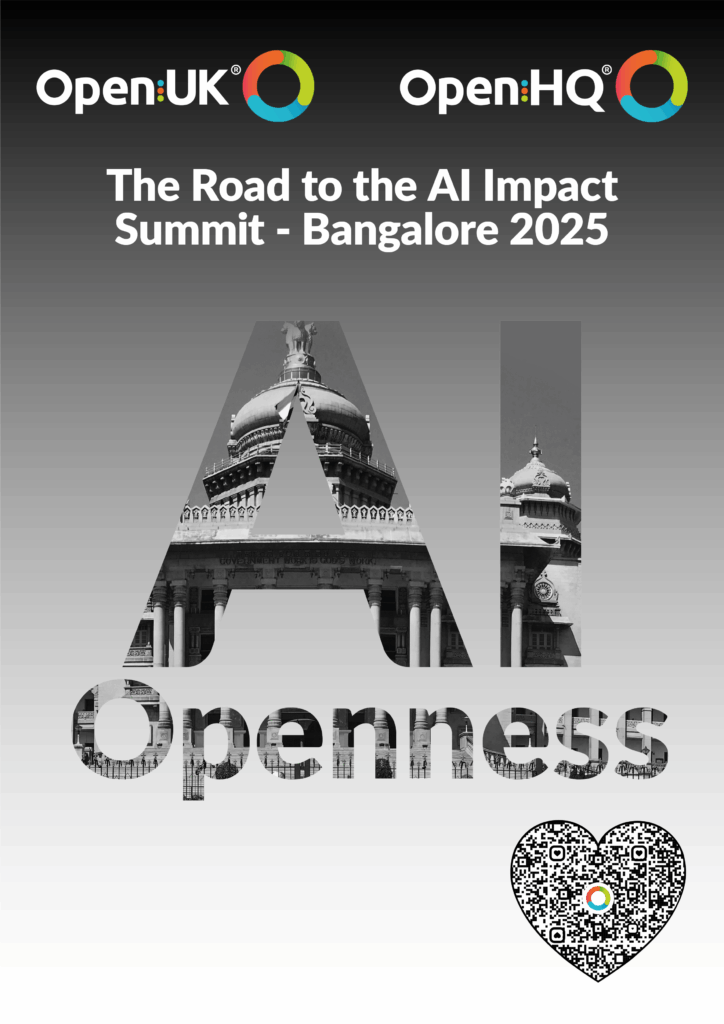
Released on 19 November 2025
Published in the lead-up to the India AI Impact Summit, this report asserts that openness is the essential foundation for the Summit’s mission of “People, Planet and Progress” and its seven thematic Chakras, introducing “Open Chakra AI”, AI that supports access for all in an open way. It brings the latest global and country data on AI openness for the top six countries in AI, with deep dives into India and the UK showing extraordinary growth in India, alongside thought leadership on Sovereignty and Data, including open source healthcare case studies from both the UK and India, contextualised in the Indian landscape by the CEO of FOSS United.
Report Includes:
Introduction and Conclusion
- Introduction to the Report, Professor Amanda Brock, CEO, OpenUK and OpenHQ
- Conclusion, Dr Jennifer Barth, Research Director, OpenUK
The Road to the AI Impact Summit
- Introduction to India’s AI Impact Summit, Abhishek Singh, Additional Secretary, Ministry of Electronics and Information Technology (MeitY), Government of India, and CEO, India AI Mission
- AI Openness: Impact, Access and Innovation, write-up of the London Roundtable and Dinner, 11 November 2025, an Official Pre-Summit Event of the AI Impact Summit 2026
Thought Leadership
- Global AI Policy in 2025, Bharath Reddy, Associate Fellow, The Takshashila Institution
- From Contest to Collaboration, the Path for AI Sovereignty, Vivek Agarwal, Country Director, India, Tony Blair Institute for Global Change
- Building India’s AI Future: From Open Models to Open Data, Rakesh Dubbudu, Founder, Factly
- The Need for Responsibly Sourced Open Datasets, Tarunima Prabhakar, Co-Founder, Tattle
- Advancing Open Source AI in India, Urvashi Aneja, Founder and Director, Digital Futures Lab
- India’s Open Source Community, Sai Rahul Poruri, CEO, FOSS United Foundation
Case Studies
- Thoughtworks: Bahmni — an open source hospital management and EMR system, Vanya Seth, Head of Technology, Thoughtworks and Julien Deswaef, Regional Head of Social Change, Thoughtworks
- Open Healthcare Network, Gigin Chandy George, Co-Founding Engineer, Open Healthcare Network
Fireside Chats
- Open Technology for Good, Vanya Seth, Head of Technology, Thoughtworks
- Building Trust Through Open Standards, Brian Bishop, Founder & CEO, Data People Connected
Data
- Global AI update and the rise of Sovereignty, including sovereignty literature review
- Hugging Face, GitHub country and AI-repository data for the US, China, EU, UK and India, with deep dives on UK and India open source and AI openness
Executive Summary
This report focuses on the Road to the India AI Impact Summit and argues that AI’s future legitimacy, innovation and global access depend on embracing open source, open standards and open data, particularly for developing nations.
Openness drives global innovation and access
- Rather than trying to define “open source AI”, focus should be on the openness of the underlying components, software, models and data; the report introduces “Open Chakra AI”: AI supporting universal access in an open way across the Summit’s seven thematic Chakras
- The opening of Meta’s Llama 2 enabled China’s DeepSeek R1 to be built at 20% of the cost of previous LLMs, a leap of iterative innovation driven by openness; within days Hugging Face iterated again with R1-Open
- Prime Minister Modi’s Paris call for “access for all” through open source is critical to shifting AI from the hands of the few to the many and bringing the Global South into AI governance
Sovereignty, dependency and trust
- The report reframes sovereignty: the real concern is dependency on a few vendors, not the origin of technology, open source provides access that breaks dependency and enables interoperability and local control
- Approaches compared: the UK’s pragmatic, non-isolationist Compute Roadmap and global partnerships; India’s mission to build domestic capability with open AI technology and a Sovereign AI team; the EU’s Eurostack linking sovereignty to open architecture but risking fragmentation through “local source”
- Linux Foundation data: 79% of organisations regard sovereign AI as strategically relevant, open source is the leading approach (81%), and 94% see global cooperation as essential, sovereignty achieved through participation in open ecosystems
Data and application in healthcare
- Data remains the critical challenge for openness in AI; India’s datasets must reflect its linguistic, cultural and socioeconomic diversity, moving public data from PDFs to clean, structured, open datasets
- Case studies show open source platforms, Bahmni (deployed in 500+ hospitals across 50+ countries) and the Open Healthcare Network’s Care (200+ government hospitals across 10 Indian states, powering Kerala’s palliative care programme with 100,000 monthly home visits) enabling local adaptation, FHIR interoperability and data sovereignty
What the data tells us
- India is sixth globally in AI repositories with 1k+ stars (60, up 50% year on year, the fastest growth globally) and second in Gen AI contributors (695,000 in 2025); GitHub projects India will be its largest developer base by 2028
- The UK is fourth globally in AI repositories with 1k+ stars (149, up 32%), holds the world’s highest per-capita open source participation with over 4 million GitHub accounts, and Scotland-based AutoGPT is the number one AI repository globally
- The US is India’s and the UK’s top collaboration partner; the UK is India’s second-largest, a notable partnership given the UK’s size
A path forward
- Concrete Summit actions proposed: standardise the definition of openness (e.g. the Model Openness Framework), financially support maximally open Class I models, and develop open alternatives to proprietary chokepoints like NVIDIA’s CUDA
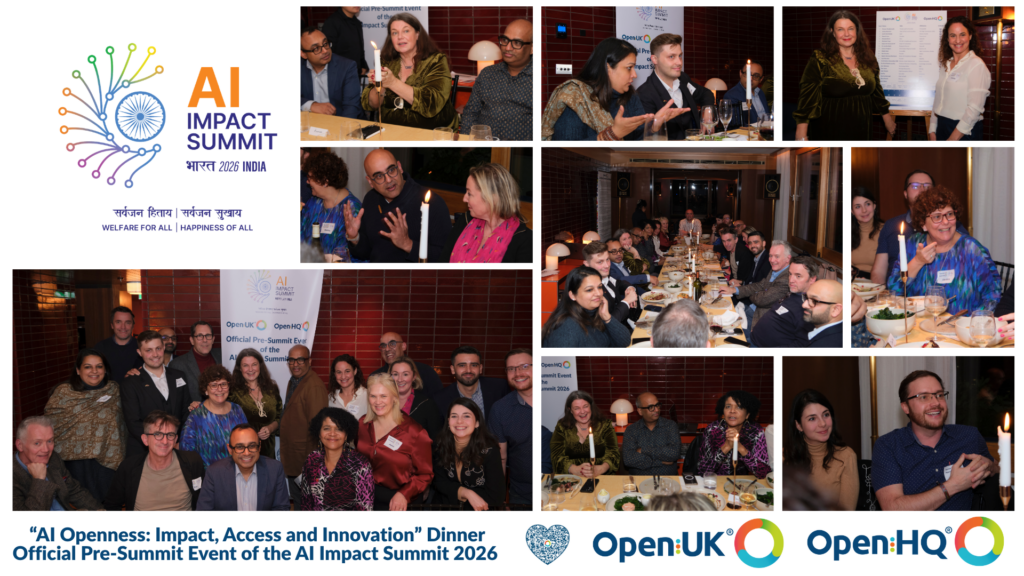
The Road to the AI Impact Summit London, Dinner and Roundtable, “AI Openness: Impact, Access and Innovation”: Official Pre-Summit Event of the AI Impact Summit 2026
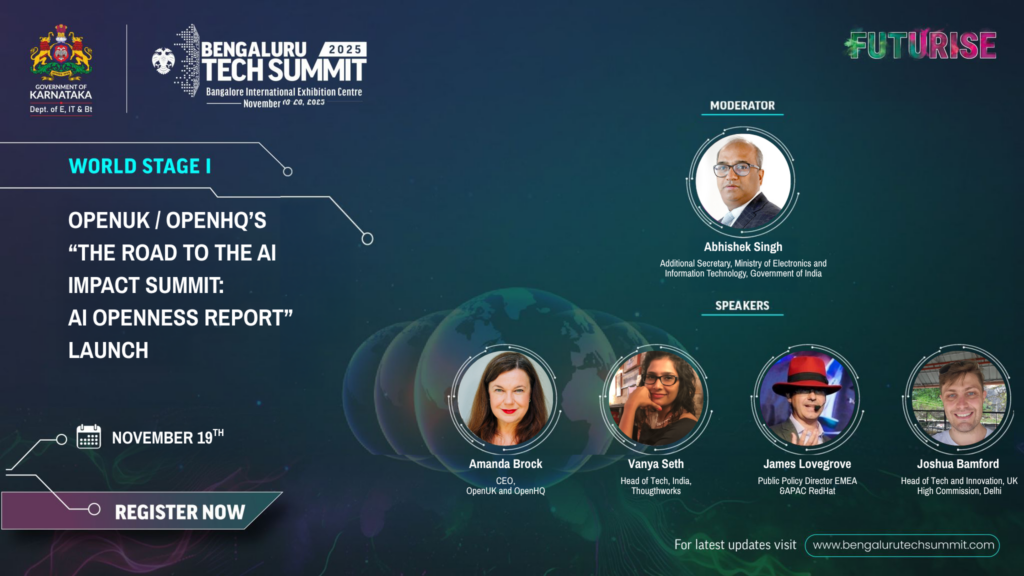
Report Launch Panel at Bengaluru Tech Summit
We were delighted to be accompanied by Impact Summit lead Abhishek Singh, Additional Secretary, MiETY who also contributed to the report, in the panel launch.
OpenUK Annual Survey
Contribute to our Research by sparing 30 minutes to complete our survey in partnership with our Economists in Residence, The PSC – wherever in the world you are, whether you are working or not and whatever sector you might work in.