
Financial Inclusion through Open Source
Kosta Peric
Open Source Africa Report 2026

Chair of Mojaloop and Deputy Director of Financial Inclusion at Gates Foundation Kosta Peric is the man who persuaded Bill Gates to build open source infrastructure for payment systems to build financial inclusion. He tells us that for many people in low and middle-income countries, a payment is their first interaction with the formal financial system. Whether it is a farmer receiving payment for goods, a government paying health workers, or a parent transferring money to a child in another city, these transactions depend on infrastructure that is reliable, safe, and affordable. When the system works, trust builds. When it fails even once, that trust can be difficult to recover.
Over the past two decades, financial access has expanded significantly. In 2011, roughly 42 percent of adults in low and middle-income countries had a formal financial account. Today, that figure stands at approximately 75 percent, representing around two billion additional people. The gender gap in access has also narrowed, from about nine percentage points to five.
This progress has been shaped by a combination of factors, including government-led infrastructure modernisation, stronger regulatory frameworks, the spread of mobile connectivity into rural areas, and the growth of agent networks beyond the reach of traditional banking. Among the most consequential developments has been the shift from fragmented payment networks to interoperable ones. When providers operate in silos, costs remain high, innovation slows, and users are forced to navigate disconnected systems. Interoperability changes this. It opens the market to new providers, drives competition, and results in better services at lower cost.
The role of open source
Mojaloop is an open source platform designed for interoperable instant payment systems. It provides the infrastructure needed to connect banks, mobile money providers, and other financial institutions so that payments can move quickly and securely across networks.
The open source model offers several practical advantages. Countries are not locked into a single vendor and can adapt the technology as their needs change. Providers compete on the quality of their services rather than over control of the infrastructure itself. Innovation can happen at the edges of the system, with fintechs and banks building new products on top of shared rails. Without licensing fees, more resources can be directed toward operations and service delivery. And countries retain control of their payments infrastructure, supporting digital sovereignty and long-term adaptability.
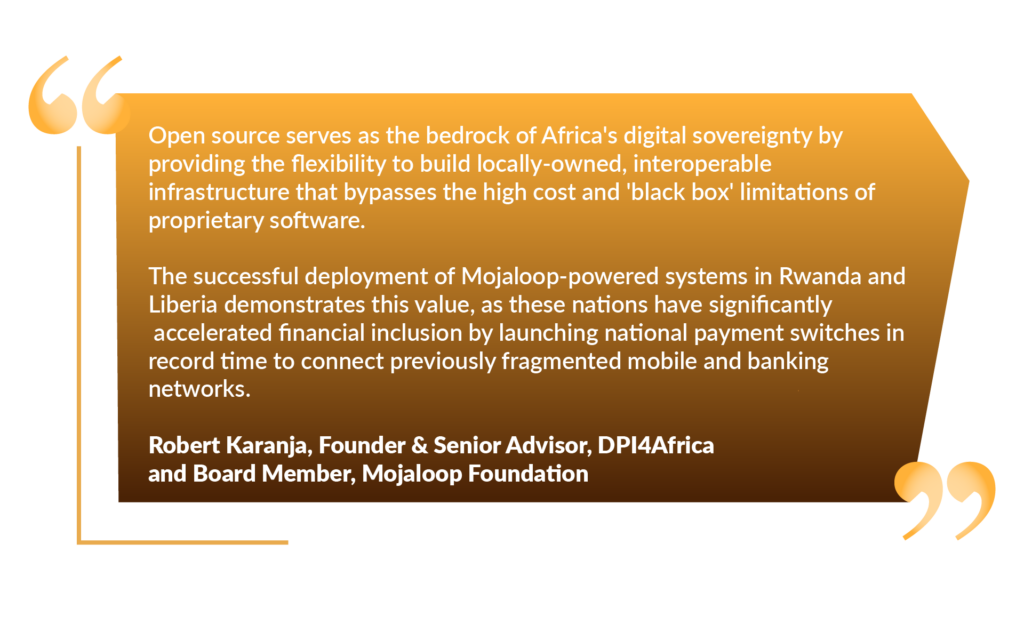
These advantages are already visible in practice. In Rwanda, interoperable digital payments have expanded access to financial services and become embedded in everyday commerce. In Liberia, interoperability across mobile money providers is building a connected payment ecosystem from an early stage. Across Africa, 25 countries now have an inclusive instant payment system in place, five more are in development, and the majority use Mojaloop as their core infrastructure.
Sustainability beyond 2030
The Gates Foundation’s Inclusive Financial Systems program, which helped catalyse much of this work, is entering its final phase and will close in 2030. The Foundation’s role was designed to be catalytic — to build infrastructure, strengthen regulatory capacity, and open markets so that financial systems could expand sustainably. Over the next five years, the priority is to help ensure that every country in Africa has an inclusive instant payment system in place, supported by strong regulatory and supervisory institutions.
The question that follows is whether these systems will endure beyond the Foundation’s direct involvement. Open source offers a credible path. Projects like Linux and the Apache Software Foundation demonstrate that shared infrastructure can thrive over the long term when sustained by active communities of contributors and institutions. The Mojaloop Foundation and the global community around it — central banks, operators, implementers, and developers — are positioned to carry this work forward.
As payment systems continue to evolve, they will need to adapt to new technologies, strengthen security, and meet rising expectations from users. Collaboration across the ecosystem, including with initiatives like the Tazama project at the Linux Foundation focused on fraud management, will be essential to maintaining trust and integrity. The measure of success will not be how many systems are operational in 2030, but whether they continue to strengthen economies and serve people effectively in the decades that follow.
Kosta Peric
In his executive role as Deputy Director at Gates Foundation, Kosta leads initiatives across Africa and South Asia that help countries design and deploy digital public infrastructure—including instant payments and cybersecurity frameworks. He works closely with policymakers, regulators, private-sector partners, and global institutions to accelerate financial inclusion. He serves as Chair of the Board of the Mojaloop Foundation, guiding the evolution of the leading open source solution for instant, low-cost payments. He is also the former Board Member of the Interledger Foundation, supporting governance and ecosystem strategy for one of the core protocols enabling secure value transfer across digital platforms.
First published by OpenUK in 2026 as part of Open Source Africa Report 2026 ©OpenUK2026
©OpenUK2026