
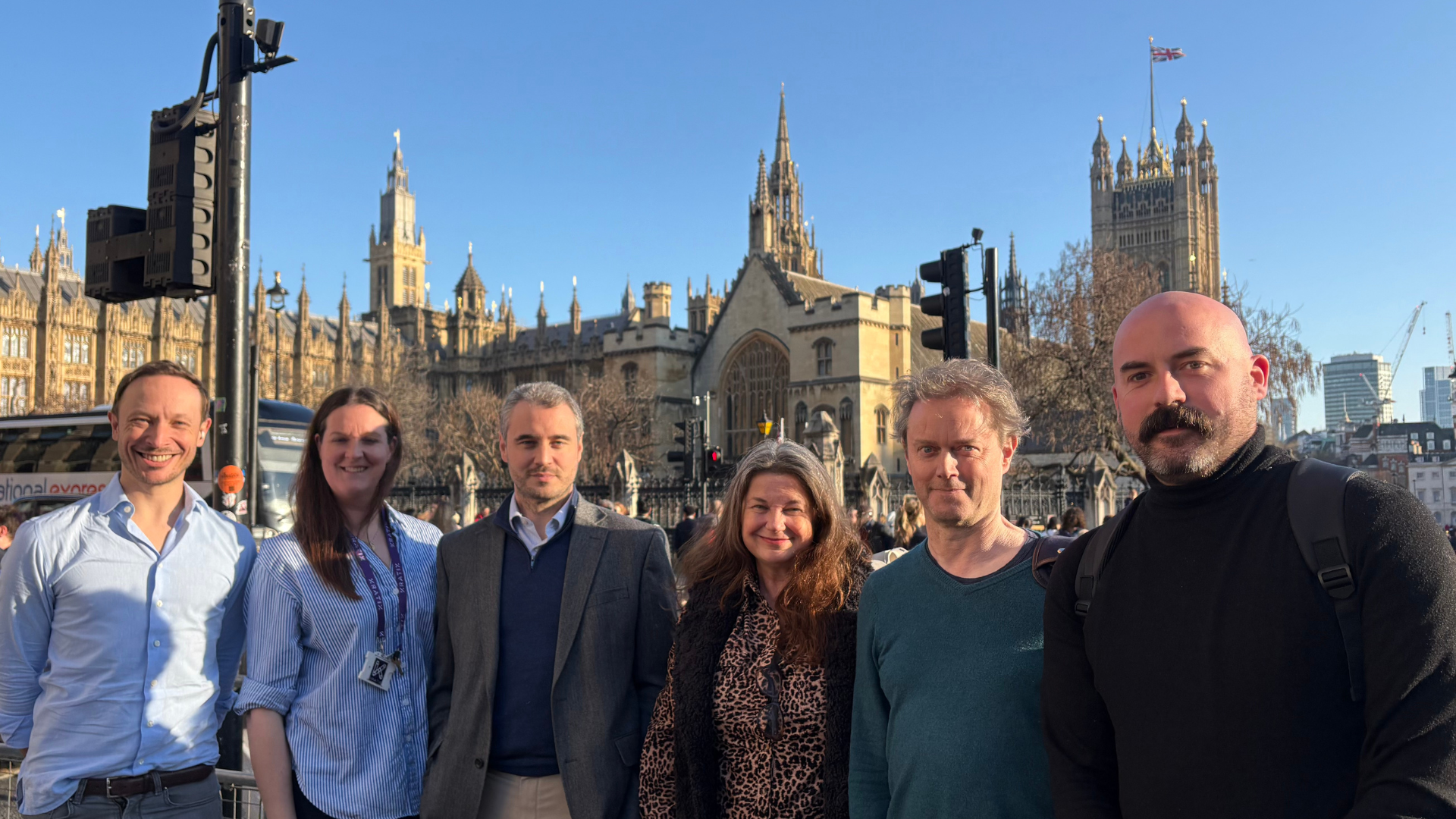
Julia Lopez MP, Shadow Digital Minister, invited OpenUK to join a roundtable discussion following a conversation with her on digital sovereignty. The meeting was attended by Lord Markham and Viscount Camrose, of the Conservatives’ DSIT Shadow Team.
Sovereignty and Open Source
Sovereignty for the UK follows the UK Compute Roadmap’s non-isolationist approach, which aligns with open source, which is based on global collaboration. It has also seen one company truly benefit via Stargate. We welcome inward investment to the UK. Dependency on a few small companies in another country is the real challenge. This can be resolved in part at least by open source.
Ensuring that open source is understood in decisions made around sovereignty at a political level is critical. We do not support the Eurostack created here type approach and recognise the need for global collaboration. This was emphasised multiple times. Open source is a cornerstone of sovereignty as it can remove dependency, ensure transparency and enable the building of a localised stack. The group recognised the five layers of a sovereign stack and the need to choose the level at which sovereignty is required.
Despite the UK being a world-leader in open source, we are not seeing the same level of political and public sector engagement from DSIT that we are seeing in other countries’ equivalents.
The visible tech sector in the UK obscures the UK’s open source deep tech leadership. Open source is simply not well understood or represented by the mainstream, with most access to policymakers. Funding for open source reporting, etc., is a good example, and as open source has become de rigueur in the conversation, this has not made engagement easier with lobbyists not including our experts.
Focus on what the UK needs
The conversation quickly evolved into what the open source community needs from the Opposition as opposed to what open source can do for the UK.
OpenUK provided 20 recommendations to UKRI as a funder and user of open source a year ago. Some are in line with other countries’ activities, such as Kenya’s capacity building, and others might be considered visionary, as was the UK’s world-leading public sector open source first strategy of 2011 under Lord Maude.
1. National Open Source Foundation
A national foundation for open source would leapfrog the current approach in other countries apart from China, which set up the Open Atom Foundation as one of the first steps in its successful open source strategy. The foundation would provide governance and management of projects, build community, collaboration and contribution and foster a sovereign software stack holding IP in the UK to retain some of the innovation leadership currently lost to the US as businesses shift and scale.
This would address the failures of the 2011 “open source first” policy and other countries’ similar policies and laws, which enable open source in name only, as they do not provide the underlying structure necessary to deliver open source in the national interest. This structure would shift power and influence to the UK as a point of global collaboration, which is currently lost today, rectifying the UK’s failure to take advantage of its strength in open source as a leader by scale and influence.
The lack of a corporate structure equivalent to the US’s 501(c) or 503(c) and Belgium’s AISBL means that the UK has missed multiple opportunities to host international foundations.
OpenUK is currently in the modelling phase of the proposed foundation, considering necessary legal structures, tax incentives, and investment, as well as the foundation’s function, which would be multi-purpose and overarching the functions of an Open Source Program Office, a Sovereign Tech Fund and a code/asset holding foundation. We would expect the model to be one that is replicated across other countries as a base-point for future collaboration. Only open source leaders can build and run this foundation if it is to be successful.
2. Support for monetisation and scaling of open source-based businesses
Open source can build influence and wealth. The conversation has shifted from a technical to a policy and influence one, as demonstrated in China’s approach to AI and the US approach to software, and in global conversations on digital sovereignty.
The UK needs to improve the environment for scaling businesses generally, but in particular to build an understanding of open source investment and risk profiling at a funding level. With many start-up founders in the room, the need for greater support through R&D tax credits and schemes like EIS was clear.
The Foundation would be accompanied by an incubator/ accelerator to enable monetisation of the IP it holds and to leverage this to generate influence.
This would also see a greater ecosystem built around projects like the AI Security Institute’s Inspect platform, which was open sourced and widely adopted, but which has not been monetised or leveraged to build a UK ecosystem monetising around it.
3. Funding and Procurement
A significant shift in public and private funding and public procurement is necessary. Upskilling and alteration in process and definition for the public sector’s engagement with open source would have a significant impact. The use of only the legal definition of open source without requirements in contribution, etc., which ensure the delivery of open source value, means that today, the UK’s funding enables a GitHub wasteland.
The objectives of funding open source – including cost savings and becoming the de facto standard/ having influence through innovation that is recycled and reused – are failing today. A National Foundation, being a home to UK-funded innovation, will support the necessary shift.
From a procurement perspective, removing lock-in through open source has failed to date. Success requires a greater understanding of open source and how its value is generated, as well as enabling smaller businesses and consortia to compete.
4. Encourage greater engagement from DSIT with open source ecosystem
DSIT, which has not fully engaged with the open source ecosystem, should be encouraged to ensure coordination of OpenUK’s work with UKRI and to leverage a joined-up approach. We hope that the Cabinet Office will also be involved.
The OpenUK Attendees who joined us and spoke were Alex Housely, Founder at Frontier Advisory, previously Founder of Seldon; Amanda Brock, CEO, OpenUK; Andrew Martin, Co-Founder and CEO, ControlPlane; Chris Eastham, Partner, Field Fisher; Chris Howard, Head of Open Source, Uber; Ed Shee, CTO, WONE (leaving Ignitus); Justin Cormack, former CTO, Docker; Martin Woodward, VP Developer Relations, GitHub; Paula Kennedy, Co-founder and COO, Syntasso; Rebecca Rumbul, CEO, Rust Foundation. We are grateful to Zin Lwin, Design Ops Manager, OpenUK, for supporting the event.


