
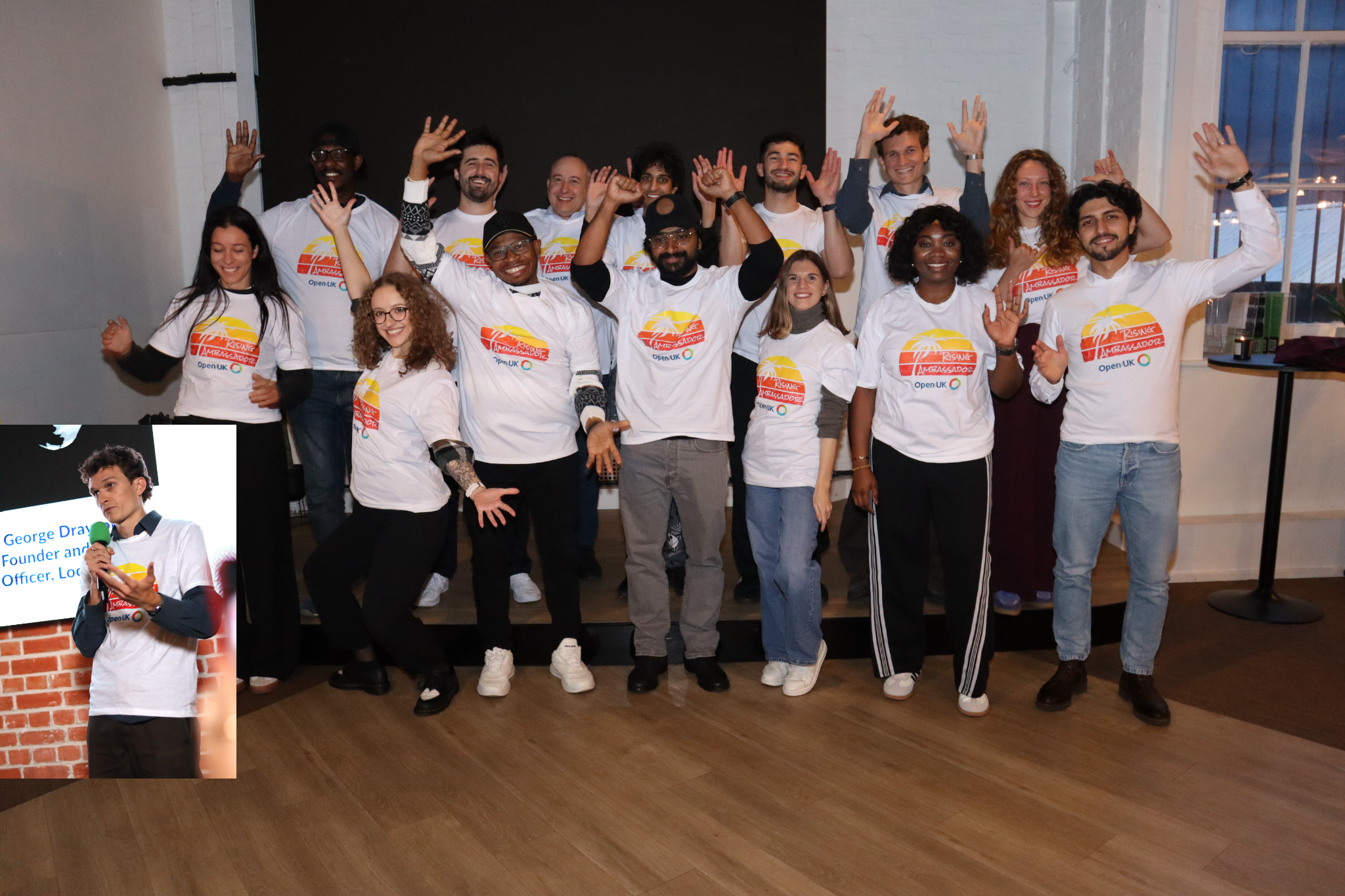
OpenUK has always been all about getting smart people to collaborate, but you know, luminaries are built from communities; so, as we enter into the new year at school, Open UK brought together their own class of 2026 with the Rising Ambassadors evening, kindly hosted by Civio.
Our cohort, of 26 in total, were especially selected to bring in new ideas, experience, and enthusiasm. They’re all considered ‘new to Open Source’ or ‘relatively new to the industry’, most of the group (not all) will have started with Public cloud, and running get’s against API’s, not running c:/ run win, or defrags because your disks doing too much ‘clicking’!
On the night we had introductions from nine of the Rising Ambassadors, all touching on AI in some form, from reducing the challenge of Optimising LLMs, to Leveraging to Securing them. Let’s dip into some of the topics here to give you a taste (Full video):
Optimising AI
George Drayson (talk) – Co-Founder and Chief AI officer – Locai Labs
George opened the showcase by extending Mark Carney’s concept of “middle powers” to AI, exploring how nations outside the US and China can innovate without colossal GPU investments. At his startup, Locai Labs, he is bringing these technologies to smaller enterprises and individuals by shrinking open-source models onto desktop-scale hardware. His team achieves this through “quantization”, the lowering weight precision (think measuring a football field in meters rather than millimeters), and pruning, which strips out parameters unneeded for the target task. Together, these techniques scale down hardware demands and speed up inference.
Sourish Sharma (talk) – Website
Sourish has been looking deeply at the improvements which can be made to AI image generation. With the goal of cutting the generation time from 20m to 1m! They were able to 2x speed-up by reducing the interim diffusion stages from 40 to 4 during generation, further speed by halving weight precision. Further optimisation came walking the process, discovering expensive calls made multiple times from an unchanging source.
A key distinction was made between Open Source AI and Open Weights AI and the incentives for investment, in the example above optimisations were engineered and put back into the community, but for Open Weights, there’s no ability to customise in the same way and less ability to monetise any investment due to the licence terms.
There were other optimisations, and some that went too far and had to be scaled back; it turns out without enough layers the model started sprinkling fairy lights on generated images!

Christie Purackal (talk) – Core Maintainer – Kornia
Christie detailed how Kornia, an open-source library he core-maintains, bridges the gap between classical computer vision and deep learning. As the project expanded into robotics, his team found that programming language choice matters immensely, adopting Rust to re-engineer foundational algorithms where existing libraries fell short.
Author’s Note: This programming shift brings to mind a parallel in human linguistics: studies show that Mandarin speakers can perform mental arithmetic faster simply because Mandarin number words are shorter, fitting more data into the mind’s ‘phonological loop’. In much the same way, choosing an optimised language like Rust streamlines how hardware processes complex spatial data!
By building robust Rust tools for critical tasks like SLAM (simultaneous localization and mapping) and model inference, Kornia is enriching the ecosystem for autonomous vehicles and physical systems. Beyond writing code, Christie emphasized the importance of industry mentorship, outlining Kornia’s work as a Google Summer of Code (GSoC) organization to train emerging talent and publish research at top vision conferences like IROS.
Harmonising with AI
David Higgins (talk) – Director of Programs – Mifos Initiative
David presented how the Mifos Initiative uses open-source software to reduce overhead costs and operational complexity for microfinance institutions, enabling financial inclusion for the global poor. Beyond software access, his team uses AI models to bridge financial literacy gaps by translating complex terms and conditions into plain, accessible language for unbanked communities.
Internally, he leads an “AI for All” working group focused on responsible AI adoption. Over the summer, they mentored entry-level developers by giving them structured access to Claude Code alongside product, legal, and engineering coaches, empowering them to use agentic tools strategically while building a clear path toward becoming senior engineers. David also highlighted how AI helps balance developer workflows: delegating tedious, repetitive tasks like generating documentation from Jira tickets and pull requests to LLMs, allowing engineers to focus on the creative work they actually enjoy.
Joseph Goksu (talk) – Senior Platform Engineer – Obrizum
Joseph joins OpenUK Rising ambassadors from his work with the Gates Foundation where he’s also been working to enable the globally unbanked to have access to financial services though the Tazama project, now under the care of the Linux Foundation. His latest project seeks to make it easy to monitor transactions (https://opensource.finance) in a lightweight way, offering a single binary deployment. The opportunities to create useful agentic AI in far shorter timelines using AI agents has really impressed him, for example, his portfolio inquiry agent which was completed in three short months. Our next speaker explores where humans uniquely bring value in this pattern.
Joseph joined the OpenUK Rising Ambassadors following his work with the Gates Foundation, where he helped expand financial access for unbanked communities through the Tazama transaction monitoring project (now hosted by the Linux Foundation). At https://opensource.finance he continues this mission with Osprey, a lightweight, single-binary tool (20MB) that lets organizations deploy transaction monitoring locally without needing large compliance or DevOps teams. Joseph highlighted how agentic AI has dramatically accelerated build timelines, his example ‘Brief Finance’, a stock market research agent he created in just three months to give retail investors market insights on their portfolio changes.
Joseph’s presentation set up a natural question for our next talk: if AI agents can build complex applications in months, where do humans uniquely bring value to the process?

Omotola Eunice Omotayo (talk) – Community Manager – Outreachy
Omotola opened her presentation with a prompt for the room: *“How many of us are working, using, or building AI across different projects?”* Hands shot up across the venue.
She followed up with a deeper challenge: “[In] trying to make our tools, projects, communities, and programs more efficient… are we making them less human?” The audience further agreed
As a researcher at the University of London examining the “role of AI-powered tools in achieving social sustainability,” Omotola posits that human empathy, relationships, and direct communication must never be outsourced to technology. To illustrate how AI can empower people rather than isolate them, she contrasted two approaches to creating technical documentation:
Scenario A: A technical writer passes raw project context straight into an LLM to generate documentation.
Scenario B: A technical writer meets directly with developers and users to explore their needs and experiences, then feeds those human insights back into the AI to generate the docs.
The second approach produces far superior, human-aligned documentation. By keeping empathy at the heart of the workflow, organizations ensure AI is used to strengthen people rather than leave them feeling left behind. [assist Omotoa’s research through a survey here]

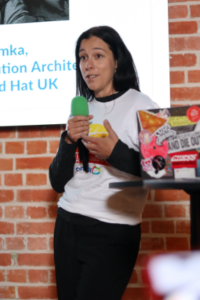
Johana Limka (talk) – Senior Account SA – Redhat
Johana shared her experience working in the banking sector, with very large GPU infrastructures. She’s noticed the need to allow more participants in these organsiations to use these transformative capabilities, seeking to deliver the advantages of the huge infrastructure investments made. To deliver this flexible and controlled access to resources is needed and made simple. This access requires competent platforms which rely on Open Source tooling in Kubernetes, Cloud Native and beyond. Overall the pay-offs on the AI investments are still developing and she sees Open source as key to unlocking that value.
Johana’s also noticed the ebb and flow of Public cloud drawing back on-shore and in house control, and critically data sovereignty is playing a part in the mind of the organisation’s leaders, particularly in the public sector.
Security in an age of AI
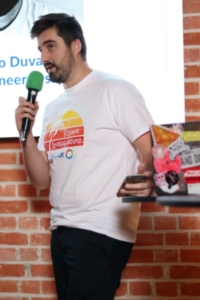
Valentino Duval (talk) – Software Engineer – Ossprey
Valentino wanted to bring the attention to some of the new attacks he’s seeing in his work for a security firm, enabled by AI.
Agents getting the wrong idea: When entrusting an agent to build, it has a ‘guess’ at what the component packages would be, and there’s about a 20% ‘invention’ rate! This is a risk, as the nefarious sorts will add packages with those names. The Open Source community do spot such malware, detection time is around three days, but it’s often too slow and too late for your local environment which can be infected using this vector of attack.
Not the Job you wanted: As we see a reduction in software engineering roles, and the number of interviews per role are increasing, scams are now abound to offer interviews to candidates (most prevalent in crypto), which infect machines during the interview exercises. The act of cloning repositories for the ‘exercise’ brings down compromises, often targeting the IDE itself as a vector and allowing those often North Korean adversaries to access your data (and presumably your crypto wallet).
Mitigations include ‘Death containers’ and restricted VMs, but if those have access to everything you’ve not solved anything! You should also always pause and consider before clicking ‘Trust this workspace’.
Setting a UK Open Source AI example
Rachael Wonnacott (talk) – Global Head of ML & Applied AI – ‘Stealth Mode’
Rachael began her career in astrophysics research before transitioning into software engineering, trading the mathematical proofs of scientific computing for object-oriented abstraction and tests.
During her decade at Fidelity International as Head of Cloud Engineering, she proved that large enterprises could successfully run on open-source software, leading the shift to an open-source Cloud Foundry platform on physical bare-metal hardware. A prominent speaker and advocate at KubeCon, Rachael actively works to build enterprise risk appetite in regulated sectors, demonstrating that software developed collaboratively across diverse disciplines is higher quality than code written in isolation.
Her upcoming role as Global Head of Machine Learning & Applied AI at a multi-trillion-dollar asset manager in London highlights the growing trust and investment in the UK’s vibrant open ecosystem to fuel applied AI innovation and long-term prosperity.
Rachael’s upcoming role as Global Head of Machine Learning & Applied AI at a multi-trillion-dollar asset manager in London highlights the growing trust and investment in the UK’s vibrant open ecosystem to fuel applied AI innovation and long-term prosperity

To read more about the state of AI in Open Source read the Open UK/Open HQ AI Openness report 2026
Thank you to all our speakers and our all our Ambassadors and we’re looking forward to our next showcase:
OpenUK London Meet-up: “Agentic AI in Financial Services”


