
Open source needs an evaluation of economic value
Open source succeeds because lots of different people and organisations show up, for different reasons, in different ways. That variety is at the heart of our ecosystem. This diversity and lack of uniformity, whether of contributors or models, are also the challenge when we try to talk about impact, investment, risk, and what “good” looks like across an ecosystem. Mark Shuttleworth, founder of Canonical, described open source as meaning different things to different people depending on their experiences of it. Legal definition aside, that experience could range from community collaboration to corporate software companies building in public to throwing complete projects over the wall just in case someone else can use them.
OpenUK has been working for five years on how to go beyond the traditional methods of valuing open source. In this work, we see a replacement cost that is focused on the cost of developers and lines of code. Our work on an economic analysis of the value of open source has evolved over that time. We have also seen a shift with Harvard and the Linux Foundation also moving to a value-generated approach. A difference between their work and ours is that they based their calculation on commercial data, which could not be shared with other organisations or cut in different ways. At OpenUK, we create our own data via our surveys to enable these economic calculations to happen.
Evolving our approach with our Economists in Residence
This year, we are working with our new Economists in Residence, The PSC, to evolve our thinking and calculate the economics of open source. We are taking a new approach, evolving what has been done in the past to use a value-chain simulation modelling approach.
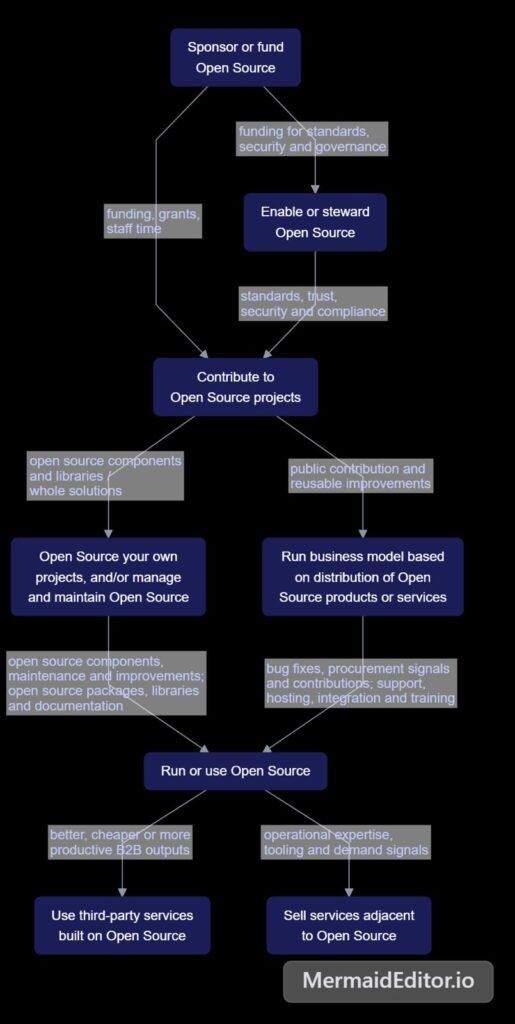
This is a practical way to describe the open source ecosystem without flattening it into something unrecognisable. As part of this, we have drafted a “value chain” for open source, a simple articulation of who is involved across the chain, what they do, and how value flows.
This is also the first attempt to quantify the economic value of open source in the UK from a value chain perspective. It is not perfect, and you are welcome to engage and give feedback to us.
An international AI Opportunity
In past years, we have assessed value from an open source software perspective. This year, we have added AI into the mix for the first time.
We have also opened a contemporaneous second survey for our global colleagues. We will begin the process of building worldwide data that can be cut by continent and country.
This will not only evolve data in those countries to support the understanding of open source in different countries, but will enable us to draw direct comparisons as this evolves and the database grows.
Our Approach
We are treating open source as a system of production and use, with at least three kinds of activity happening at once:
- People and organisations create, share and maintain open source.
- People and organisations adopt and run open source to deliver outcomes.
- People and organisations wrap open source with services or proprietary products.
That framing matters because when we ask about economics, we need to separate “who builds” from “who benefits” and also capture the messy overlaps.
The Value Chain
Here is the value chain view we are using.
It starts upstream with funding and ends downstream with business and societal outcomes, while recognising the real-world feedback loops. The actors that we have identified are individuals and organisations who:
- Run or use open source
- Use third-party services built on open source
- Contribute to open source projects
- Open source your own projects, and/or manage and maintain open source
- Business model based on distribution of open source products or services
- Sell services adjacent to open source
- Enable or steward open source
- Sponsor or Fund open source
These are deliberately written as verbs, not identities. We recognise that many individuals and organisations will sit in more than one place; for example, a bank might fund contributions, maintain a few projects, run open source internally, and buy cloud services built on open source.
The roles organisations play as actors in open source:
Actor 1: Using open source
Running or using open source software or AI to deliver internal capability, products, or services.
Actor 2: Use third-party services built
Organisations often benefit from open source without running it directly or even being aware that they are using it. They use services built on open source, such as SaaS products or cloud services, where open source is a major input.It is also economically important, because value can show up as lower input costs and higher productivity in sectors that are not “software companies” on open source
Actor 3: Contributing and maintaining
This includes contributions to and the maintenance and management of open source software or AI.
Actor 4: Open source software or models
Some organisations openly publish software or AI models they have built on an open source licence and may sustain them open source over time.
Actor 5: Business model based on distribution of open source products or services
Running a business with one or more business models complimentary to open source, where open source is at the heart of the business.
Actor 6: Selling Services adjacent to open source
Making open source usable and trustable at scale requires technical and governance hygiene. It also includes making it secure. This includes activities like standards, compliance, assurance, audits, policy, and cybersecurity.
Actor 7: Enable or steward open source
Providing the trusted environments that enable open source projects to be managed and communities to be built around them to safeguard their long term openness based on good practices.
Actor 8: Sponsor or fund
This is an actor that makes paid open source activity possible at scale. Sometimes that is direct grant funding. Sometimes it is staff time allocated inside a company. Sometimes it is membership fees, foundations, or pooled investments.
How you can help
If you have 30 minutes, please take the survey as soon as you can and share with others who might be willing to / across your networks.
If you have any thoughts then we would value your perspective. For example:
- Do any actor types feel missing, unclear or wrongly grouped?
- Is there anywhere this framing fails to reflect how open source actually works?
- What definitions would you want written down or clarifying, so people interpret the categories consistently?
We will treat responses as input for the next iteration of this framework, and we will be explicit about what changes.
The timeline for this is that the Survey will run until September, and then we will share our UK analysis in a report scheduled for 5th October, followed by our international update in the weeks that follow.
Thanks to those who complete and share the survey. We are grateful, as always, for your support.
Dr Jennifer Barth, Professor Amanda Brock, and Karan Saini, OpenUK and OpenHQ
David Chappell, Jack Robinson and Hanyi Wang, The PSC
Recent Posts
 What Telecoms Can Teach AI About Openness
 Sovereignty, policy, and OpenUK with Amanda Brock, Open Source Security Podcast
 Open-weight models and SS1/23: can you validate what you can’t fully open?
 OpenUK’s Rising Ambassadors Evening September 10th 2026
 Your AI agent shouldn’t spend blindly: open standards keep it honest